
The Principle of Biosimilarity
Holistic comparative development process

Proof of biosimilarity at all levels is key
At Valerius, we are committed to develop biosimilars of highest quality by complying with the rigorous directives imposed by leading health authorities for highly regulated markets. Our ultimate goal is to deliver biosimilars that are interchangeable with their reference product. This implies that, despite of potential microheterogeneities, our biosimilars are developed to be as safe and as effective as the corresponding branded drugs.
To accomplish this, a holistic comparability approach is required and integrated in our development programs:
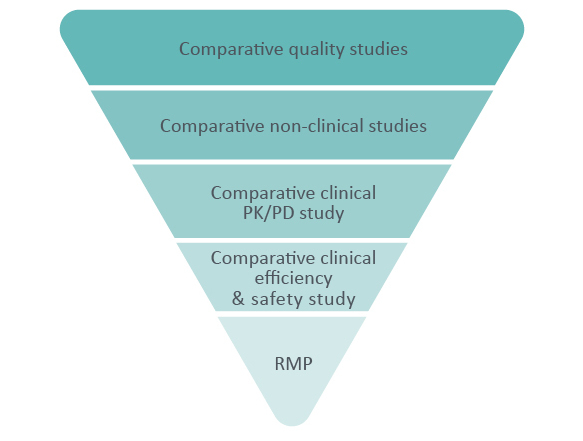
Learn more about the head-to-head comparison between biosimilars and their reference medicinal products performed during each development step:
Comparative quality studies
Comparative quality studiescThe quality of our biosimilar candidates is built in at the very early development stages, where we ensure that critical product attributes, which could impact on safety and efficacy, match or highly resemble those of the reference product.
Our biosimilar development therefore starts with the definition of the initial Quality Target Product Profile (QTPP), which is based on a comprehensive characterization of the structural and functional properties of several reference product lots. During cell line development, hundreds of cell clones are then screened to identify the lead-clone, producing the biosimilar candidate showing best conformity with the QTPP.
With their in-depth knowledge of upstream and downstream process development, our scientists and engineers design a small-scale manufacturing process that is tailored to each specific biosimilar. The process is required to deliver considerable yields of highly purified proteins exhibiting the desired quality, before it is scaled-up to the final commercial scale. Following scale-up, our analytical experts continue to characterize the physicochemical, biological, and immunochemical attributes as well as the purity and impurity profiles of the proposed biosimilar compared to the reference. During this stage, special attention is paid to differences observed in protein attributes with known immunogenic potential, such as the glycosylation profile or aggregation.
Comparative non-clinical studies
DIn order to demonstrate the highly similar biological activity of our proposed biosimilar and the reference, their pharmacological behavior is characterized as part of non-clinical in-vitro studies. In a head-to-head comparison, target binding, signal transduction and functional activities are analyzed using sensitive assays, representative of the respective clinical context.
Based on the comparative quality and non-clinical in-vitro data, as well as on the availability of relevant animal models, we then proceed with in-vivo testing. Animal studies are performed to further assess the pharmacokinetic / pharmacodynamic and safety of the biosimilar and the branded drug in a comparative manner, before entering clinical trials in humans.
Comparative clinical PK/PD study
To predict a comparable in-vivo activity of the proposed biosimilar and the reference product, a bioequivalence study is performed in a sensitive and homogeneous population of either healthy volunteers or patients. After the same dose administration of the biosimilar candidate and the branded drug, their concentration in the study subjects` plasma or serum is quantified at pre-defined time points using highly sensitive and specific methods. The data obtained are used to determine and to compare pharmacokinetic parameters. If suitable pharmacodynamic markers are available, which can be related to the clinical outcome, these are added to the bioequivalence study.
Bioequivalence studies are performed to reveal differences between the originator and the biosimilar in their interaction with the human body, and are thus used to predict a comparable in-vivo performance in terms of safety and efficacy.